


It’s easy to confuse feeling uncomfortable with being unsafe. Both can make us want to step back, avoid a situation, or return to something familiar. But they aren’t the same—and learning to recognize the difference can open up possibilities we might otherwise miss.
Learning music can make us feel surprisingly vulnerable. We’re asking our voices, hands, and ears to do unfamiliar things—and often letting someone else witness the effort before we feel ready.
That can be uncomfortable. It can also be part of what makes learning meaningful.
Discomfort can make us feel challenged. But being challenged isn’t the same as being unsafe.
A difficult passage, an unfamiliar sound, or an invitation to perform can bring uncertainty to the surface. We may feel frustrated, self-conscious, or doubtful of our abilities. Those feelings don’t necessarily mean something is wrong. They may mean we’re working at the edge of what we currently know how to do.
The conditions around that challenge matter.
In a supportive learning environment, you can struggle without being shamed. You can ask why you’re being asked to try something, explain what feels difficult, and have a say in how you move forward. Your teacher listens and helps you find a manageable next step.
That support doesn’t remove every uncomfortable feeling. It gives you somewhere to put those feelings—a conversation, a question, a shared laugh, a moment to regroup—so they don’t have to take over the experience.
Of course, discomfort isn’t something we should automatically dismiss or push through. Pressure, ridicule, and disregard for someone’s boundaries don’t become acceptable simply because they’re presented as teaching. Trust grows when concerns are heard and taken seriously.
A thoughtful teacher can hold both ideas at once: you deserve to feel respected and protected, and you’re capable of working through something difficult. “We can do hard things” may be a familiar phrase, but there’s real encouragement in discovering that it’s true—with support and room to find our way.
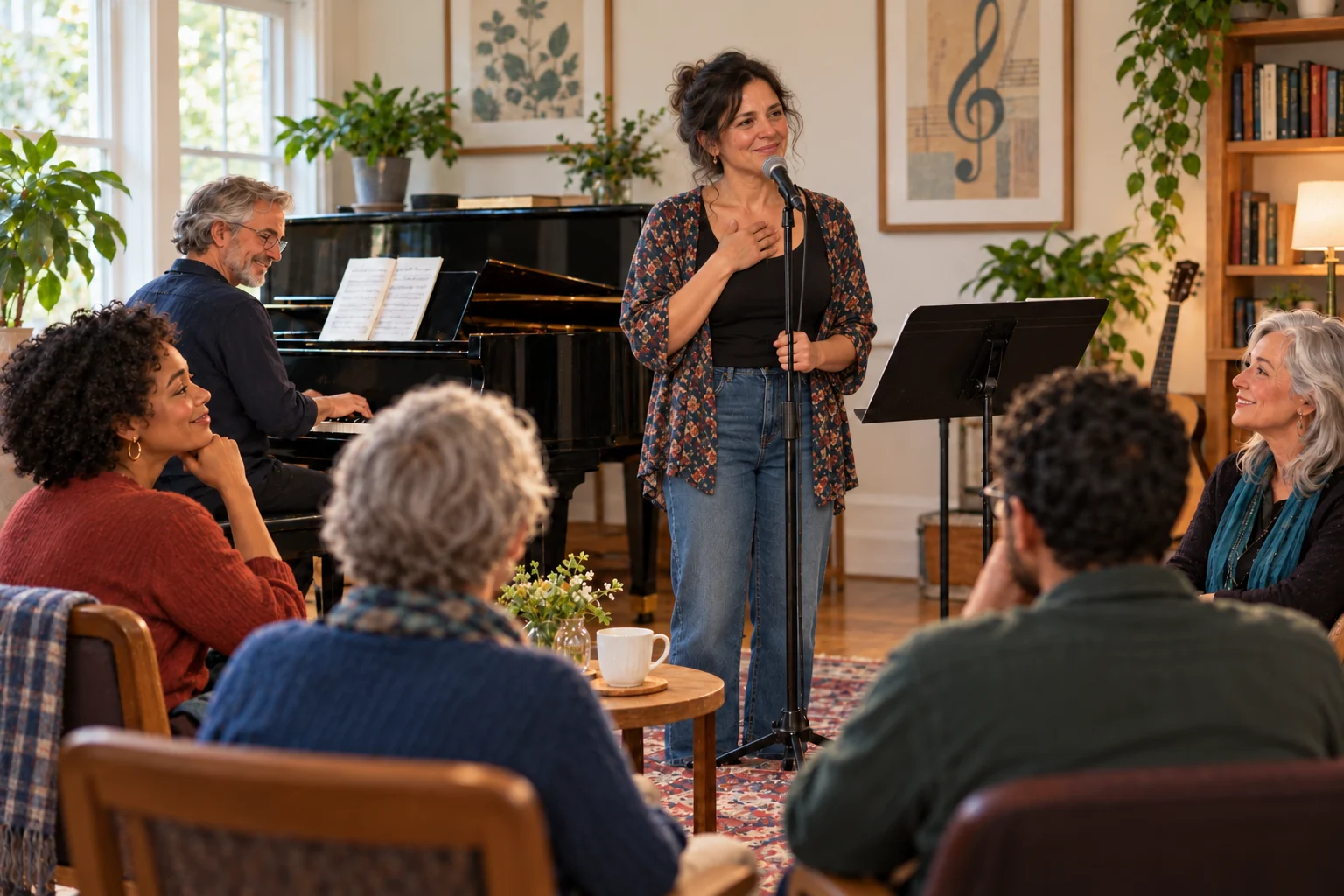
Community helps us believe that, too. When someone admits to feeling nervous, our own nerves feel less isolating. We begin to understand that uncertainty is something we can share, rather than something we have to conceal. I’ve seen this happen at our Cabaret Nights: a first-time performer who feels overwhelmed begins to relax when a returning performer says, “I feel like that too. I’m so nervous, my knees shake. But you’ll get through it, I promise.” Those moments are beautiful to witness. The challenge is still there, but now there’s a sense of belonging alongside it.
At Cantabile, we work to create a community where students have room to take those chances. That means paying attention to the person as well as the music: their goals, their readiness, and the support they need that day.
An invitation to perform, for example, might lead to playing for one trusted person before joining a recital. That smaller step still asks for courage. It also gives the student a chance to experience the challenge with enough support to stay curious and engaged.
Over time, discomfort can become more tolerable—and even enjoyable. There’s excitement in trying something you aren’t certain you can do. There’s satisfaction in discovering that a mistake is recoverable, that another attempt is possible, and that the people around you are still rooting for you.
We don’t have to wait until we feel completely confident to learn. We need a place where challenge comes with care, where our boundaries matter, and where we have the time and support to grow.